Église gréco-catholique ukrainienne
Felix AustriaThe Ukrainian Greek Catholic Church is a Catholic church that retained the Eastern rite and the ordination of married men while acknowledging Rome. In the novel, it is at once an institution taking shape in Stanislaviv, a presence in public debates about Ukrainian collective life, and a religious setting whose rituals and sacred objects become entangled with questions of miracle, crime, and belief. Its history is described through concrete buildings and ecclesiastical figures, while its meaning is tested in the lives of people who serve, pray, doubt, and interpret signs.
Identity and historical position
The Church is also called the Uniate Church and the Catholic Church of the Eastern or Byzantine rite. Its origins are traced to the Union of Brest in 1596, when part of the Orthodox Church in the eastern Ruthenian provinces of the Polish-Lithuanian Commonwealth acknowledged the authority of Rome. The union did not erase Eastern practice: the Church retained its liturgy and Julian calendar, and continued the custom of ordaining married men as priests. It therefore belongs to the Catholic Church while preserving a distinct rite and clerical tradition.
That combination matters in the novel’s religious world. The Church is neither represented simply as an extension of Roman Catholic practice nor as a community detached from Rome. Its institutional identity rests on holding both affiliations together, a structure reflected in the work’s attention to local liturgy, priests, confession, veneration of icons, and the ordinary circulation of church life through the city.
Buildings, restoration, and public presence
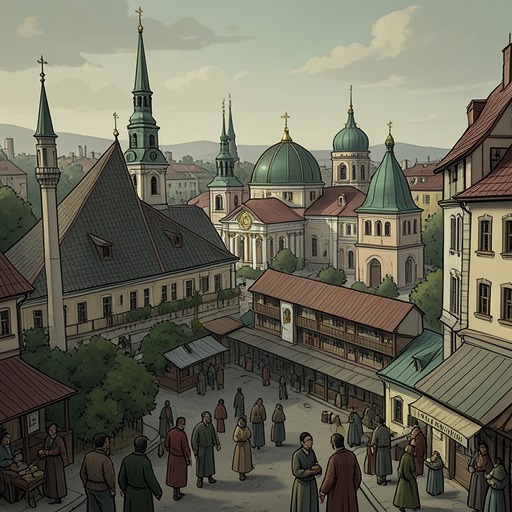
The institution becomes visible in Stanislaviv through buildings whose fortunes record both neglect and renewed investment. At No. 16 on Lindengasse, the residence later associated with Andrey Sheptytsky had been allowed to deteriorate in the 1880s under the lawyer Przybylowski’s widow. Count Potocki bought the property and formally gave it to the Church. Its restoration seemed uncertain because it was not clear whether the faithful could raise enough donations, but the work was completed. Before Sheptytsky’s arrival, the residence had housed two successive archbishops named Julian.
The street’s ecclesiastical infrastructure was still expanding. A higher college of the Greek Catholic Church occupied Madame Szczepanska’s house, although its exterior staircase intruded across half the pavement. Doctor Katzenellenbogen had asked the municipal council to remedy the obstruction, but the staircase remained, an incidental sign that institutional presence and everyday civic administration did not always fit neatly together. Across the street, construction began on a Greek Catholic seminary. Sheptytsky had acquired and donated the building for that purpose, making the project an example of direct ecclesiastical patronage and a visible investment in future clergy.
These developments appear alongside proposals for broader Ukrainian institutions. Adèle remarks that a Greek Catholic seminary will soon rise through Sheptytsky’s efforts, while Petro adds that Sheptytsky has agreed to take part in establishing a Ukrainian secondary school, though he doubts it will come to fruition. The seminary is presented as an active project; the school as a more uncertain ambition. Together they place the Church within a wider discussion about whether Ukrainian public and educational life can be organized and sustained.
Leadership and religious renewal
Sheptytsky is associated with the Church’s rising institutional energy. The narrative identifies him as a priest ordained in 1892, bishop of Stanislaviv in 1899, and metropolitan of the Greek Catholic Church in 1900, an office he held until his death in 1944. His activity in the city is concrete: he provides the seminary building and participates in the proposed Ukrainian secondary school. He also appears in Père Josef’s account of an apostolic mission among the Hutsuls of Kosiv.
In that account, Sheptytsky’s preaching and work in confession bring listeners to tears and repentance. Père Josef admires his ability to address people in their own language and to reach what had been neglected within them. The priest’s praise is not a neutral institutional record; it comes through a conversation that also contrasts Ukrainian disunity with the organizational efforts of Germans and Jews. The Church’s renewal is thus presented as both a religious undertaking and a challenge to build cohesion within a community that characters describe as divided.
Petro calls the Church’s revival evidence that things are changing locally. He invokes Julian Pelesh, described as the first bishop of the Eastern-rite Catholic Church in Stanislaviv, praising his achievements and his former role as tutor to Crown Prince Rudolf. At Pelesh’s installation, the heir to the throne reportedly gave him two pairs of white horses and a carriage. The detail links ecclesiastical advancement to imperial patronage and ceremony. Stefania, however, punctures the celebratory account by arguing that Pelesh’s apostolic work cannot have been perfect if Rudolf later killed himself at Mayerling after murdering his mistress. Petro responds with anger at the servant’s intervention, revealing how church history, imperial reputation, and household hierarchy collide in conversation.
Worship, devotion, and sacred objects
The Church’s devotional life is represented through prayer, confession, and the veneration of the Stanislaviv icon of the Virgin of Tenderness. Père Josef studies the icon’s detailed register of people who received grace or witnessed miracles. Its entries give names, dates, petitions, and claimed outcomes: in 1742 Marianna Yakoubovytch reportedly recovered after praying before the icon, and the Jesuit priest Mykola Sacher recorded relief from a severe headache after prayer. Another entry describes the icon appearing amid blue clouds during a funeral service, a vision confirmed by Brother Dominique Donikevytch.
Josef’s interest in the icon is connected to his investigations of hypnosis and religious faith. He considers whether miraculous cures attributed to saints might operate through a mechanism comparable to hypnotic treatment. The novel therefore places formal devotion and naturalistic inquiry beside each other without reducing one to the other: the register preserves reported experience, while Josef searches for an explanation. The icon’s power in the narrative lies partly in the unresolved space between testimony, belief, and interpretation.
Confession is also presented as an institutional rule with immediate human consequences. When Stefania seeks confession in a prison setting, Père Josef tells her he cannot perform the sacrament outside a church, while she cannot enter the church because it is inside the prison. Stefania argues that a sinner, a priest, and God are present, but the priest’s obligation remains bounded by the proper place for the rite. Her collapse into tears makes the distinction more than a technicality: the institution’s sacramental order encounters a desperate need that its location prevents it from meeting.
Relics, theft, and the limits of explanation
The Church’s sacred material culture is caught up in a wave of unexplained thefts from religious sites. Petro reports that an ancient monstrance has vanished from Saint Anne’s Cathedral at Ozeriany without signs of entry, witnesses, or disorder; doors were locked and windows intact. The absence of ordinary evidence invites an imagined supernatural explanation, as if angels had carried the object through the walls. Elsewhere, two gold patens disappear from a recently restored cathedral at Mykulyntsi, though the priest and deacon had locked them in a metal chest the night before. The chest is found open, its only key belonging to the priest, and both men are arrested.
The pattern crosses religious communities. A silver candy dish kept in the secret compartments of the Old Synagogue at Tchortkiv disappears; Rabbi Moshe says it was intended to hold the etrog and contained something else whose nature must remain secret. At the synagogue in Brody, a sacred kiddush cup, a hanukkiah with a walking golden lion, and an emerald-inlaid yad vanish. Accounts of the thefts are joined to a remembered Brodersinger pantomime in which Yahweh Sabaoth transports the Jewish people toward the heavenly Jerusalem: first their belongings, then their temples, animals, and houses, followed by the people themselves. In a period already shadowed by the fear that the world is nearing its end, missing objects become a source of religious and communal alarm.
The stolen objects are eventually brought together in the image of the stone woman whose fall into the burning room releases them from the jar on her head. Among them are the monstrance, the two gold patens, the jeweled chest, the etrog dish, the darkened kiddush cup, the golden-lion hanukkiah, and the emerald-set yad. Their appearance supplies a material connection between thefts that had seemed scattered across Christian and Jewish places of worship. It also reframes the mysteries through the movement and concealment of objects, rather than confirming the early apocalyptic or angelic interpretations.
The institution’s narrative significance therefore extends beyond its formal structure. Its restored residence and planned seminary make religious renewal visible in the city; its leaders become participants in debates over Ukrainian unity and education; its rites establish obligations that can both sustain and constrain those seeking spiritual help. At the same time, the Church’s sacred objects share the story’s wider vulnerability to disappearance. In the novel’s religious landscape, institutional confidence, devotional testimony, and material evidence coexist, but none alone settles what counts as a miracle or what has happened to the missing.